

Automotive PCB Market Set to Accelerate as EV Adoption and Smart Vehicle Electronics Surge 2026 | DataM Intelligence
Automotive PCB Market
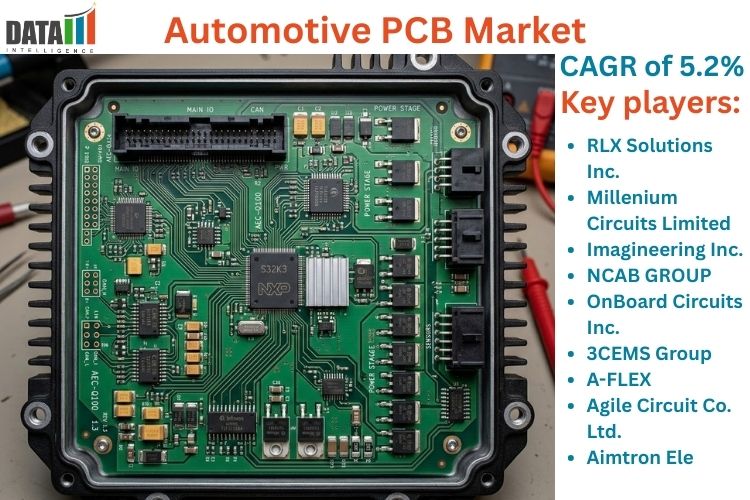
The Global Automotive PCB Market is estimated to grow at a CAGR of 5.2% during the forecast period 2024-2031.
The Automotive PCB Market is expanding steadily as vehicles adopt advanced electronics, ADAS, and EV technologies, driving strong demand for high-performance, reliable printed circuit boards.”
AUSTIN, TX, UNITED STATES, March 9, 2026 /EINPresswire.com/ -- Market Overview:— DataM Intelligence
The Automotive PCB Market is witnessing rapid expansion as modern vehicles increasingly rely on advanced electronic systems for safety, connectivity, and performance optimization. Automotive printed circuit boards (PCBs) serve as the backbone of vehicle electronics, enabling the operation of engine control units (ECUs), advanced driver-assistance systems (ADAS), infotainment platforms, battery management systems, and electric powertrains. With the global shift toward vehicle electrification, connected car technologies, and autonomous driving, the demand for reliable and high-performance automotive circuit boards is growing steadily. Automakers are integrating a higher number of electronic components into vehicles to enhance efficiency, safety, and driver experience, thereby boosting the adoption of multilayer PCBs and high-density interconnect (HDI) boards.
To Download Sample Report Here: https://www.datamintelligence.com/download-sample/automotive-pcb-market
The primary drivers behind this growth include the rising adoption of electric vehicles (EVs), increasing integration of electronic systems in vehicles, and expanding demand for advanced safety technologies such as ADAS and autonomous driving solutions. Among product types, multilayer PCBs dominate the market due to their ability to support complex electronic systems in modern vehicles. Geographically, Asia-Pacific leads the global market, driven by the presence of major automotive manufacturers, strong electronics production capabilities, and rising EV adoption in countries such as China, Japan, and South Korea.
Key Highlights from the Report:
The Automotive PCB Market is expected to grow steadily due to the increasing integration of electronic systems in modern vehicles.
Rising electric vehicle adoption is significantly boosting demand for high-performance automotive circuit boards.
Multilayer PCBs dominate the market owing to their ability to handle complex electronic architectures.
Advanced driver-assistance systems (ADAS) and autonomous driving technologies are key growth drivers for automotive PCBs.
Asia-Pacific remains the leading regional market due to strong automotive manufacturing and electronics production.
Continuous innovation in lightweight and high-density PCB technologies is shaping the future of automotive electronics.
Market Segmentation:
The Automotive PCB Market can be segmented based on PCB type, application, vehicle type, and material type, reflecting the diverse requirements of modern vehicle electronics.
Based on PCB type, the market includes single-layer PCBs, double-layer PCBs, multilayer PCBs, flexible PCBs, and rigid-flex PCBs. Among these, multilayer PCBs hold the largest market share due to their ability to support compact designs and high component density required in advanced automotive electronics. Flexible and rigid-flex PCBs are also gaining popularity as they allow lightweight design and improved durability, making them suitable for applications in electric vehicles and compact electronic modules.
In terms of application, automotive PCBs are widely used in powertrain systems, body electronics, safety systems, infotainment systems, and ADAS modules. Safety systems and ADAS applications are expected to witness the fastest growth due to strict regulatory requirements and increasing consumer demand for advanced safety features. Powertrain electronics also represent a major application area, particularly in electric and hybrid vehicles where PCBs play a critical role in battery management and motor control systems.
From a vehicle type perspective, the market is divided into passenger vehicles and commercial vehicles. Passenger vehicles dominate the market due to higher production volumes and the rapid integration of advanced electronics in cars. However, commercial vehicles are also witnessing increasing adoption of electronic control systems, telematics, and driver-assistance technologies, contributing to market expansion.
Additionally, based on material type, the market includes FR-4, polyimide, ceramic, and metal-core PCBs. FR-4 materials remain widely used due to their cost-effectiveness and reliability, while metal-core PCBs are gaining traction in EV applications due to superior heat dissipation capabilities.
Speak to Our Analyst and Get Customization in the report as per your requirements: https://www.datamintelligence.com/download-sample/updated/automotive-pcb-market
Regional Insights:
The Asia-Pacific region leads the global Automotive PCB Market and is expected to maintain its dominance throughout the forecast period. Countries such as China, Japan, South Korea, and India are major automotive manufacturing hubs with strong electronics supply chains. China, in particular, is the largest producer and consumer of electric vehicles, which significantly drives demand for advanced automotive PCBs. Additionally, the presence of leading PCB manufacturers and government support for EV adoption further strengthens the region’s market growth.
North America represents another significant market due to strong investments in automotive innovation, autonomous driving technologies, and electric vehicle development. The United States has seen increasing demand for high-performance automotive electronics as automakers integrate ADAS, connected vehicle technologies, and infotainment systems into their vehicles.
Europe also holds a substantial share in the market, supported by stringent vehicle safety regulations and the rapid transition toward electric mobility. Countries such as Germany, France, and the United Kingdom are investing heavily in EV development and automotive electronics research. The presence of leading automotive manufacturers and technology companies further drives demand for advanced automotive circuit boards across the region.
Meanwhile, Latin America and the Middle East & Africa are emerging markets where automotive electronics adoption is gradually increasing. Although these regions currently hold smaller market shares, improving automotive production capacity and rising vehicle electrification are expected to create new growth opportunities.
Market Dynamics:
Market Drivers
One of the primary drivers of the Automotive PCB Market is the rapid growth of electric vehicles (EVs) worldwide. EVs require advanced electronic systems such as battery management systems, inverters, and power control units, all of which depend heavily on high-performance PCBs. As governments promote sustainable mobility and reduce carbon emissions, the adoption of EVs is accelerating, directly boosting demand for automotive PCBs.
Another major driver is the increasing integration of advanced driver-assistance systems (ADAS) and autonomous driving technologies. Modern vehicles incorporate features such as adaptive cruise control, lane departure warning, automatic emergency braking, and collision detection systems. These technologies rely on sophisticated electronic components and sensors, which require reliable PCB designs to ensure performance and safety.
Additionally, the rising popularity of connected vehicles and infotainment systems is driving PCB demand. Consumers expect seamless connectivity, navigation, and entertainment features in vehicles, which increases the complexity of automotive electronic systems and the need for advanced circuit boards.
Market Restraints
Despite strong growth potential, the Automotive PCB Market faces several challenges. One of the key restraints is the high cost of advanced PCB manufacturing technologies, especially for multilayer and high-density interconnect boards used in automotive electronics. These technologies require specialized materials and complex production processes, increasing manufacturing costs.
Another restraint is the strict reliability and safety requirements in the automotive industry. Automotive PCBs must withstand extreme temperatures, vibrations, and harsh operating environments. Meeting these stringent quality standards can increase development time and production costs for manufacturers.
Supply chain disruptions and shortages of electronic components can also impact the market. The global semiconductor shortage experienced in recent years highlighted vulnerabilities in the automotive electronics supply chain, which can indirectly affect PCB production and availability.
Market Opportunities
The transition toward autonomous vehicles and smart mobility solutions presents significant opportunities for the Automotive PCB Market. As vehicles become increasingly automated, the number of electronic components and sensors required will continue to rise, driving demand for advanced PCB technologies.
Another promising opportunity lies in the development of lightweight and flexible PCB solutions. These designs can improve vehicle efficiency, reduce overall weight, and enhance design flexibility for automakers. Flexible and rigid-flex PCBs are particularly suitable for compact electronic modules used in modern vehicles.
Furthermore, the expansion of electric vehicle infrastructure and battery technologies is expected to create additional demand for automotive PCBs. As EV charging networks and energy management systems grow globally, PCB manufacturers will find new opportunities to develop innovative solutions for automotive electronics.
Looking For Full Report? Get it Here: https://www.datamintelligence.com/buy-now-page?report=automotive-pcb-market
Frequently Asked Questions (FAQs):
How big is the Automotive PCB Market globally?
What is the projected growth rate of the Automotive PCB Market during the forecast period?
Who are the key players operating in the global Automotive PCB Market?
What factors are driving growth in the Automotive PCB Market?
Which region is expected to dominate the Automotive PCB Market by 2032?
Company Insights:
Several leading companies are actively operating in the Automotive PCB Market and investing in advanced manufacturing technologies to strengthen their global presence.
RLX Solutions Inc.
Millenium Circuits Limited
Imagineering Inc.
NCAB GROUP
OnBoard Circuits Inc.
3CEMS Group
A-FLEX
Agile Circuit Co. Ltd.
Aimtron Electronics Pvt. Ltd.
Alfatron
Recent Developments:
United States:
February 2026: Market‑size reports covering 2025 data indicated that the U.S. automotive PCB segment has overtaken prior years’ growth rates, supported by faster EV adoption and higher electronic content per vehicle, with North America expected to remain a key growth region through 2030.
February 2026: Leading U.S. automotive‑electronics suppliers began shifting toward halogen‑free and low‑signal‑loss laminates for PCBs inside next‑generation EVs and ADAS modules, reflecting tightening environmental and EMC standards.
January 2026: U.S. automotive OEMs deepened partnerships with local PCB and electronics‑assembly firms to reduce dependence on offshore sourcing, driven by recent supply‑chain resilience regulations and incentives for domestic EV‑component manufacturing.
January 2026: Several U.S. PCB fabricators serving Tier‑1 automotive suppliers announced capacity expansions and new high‑density interconnect (HDI) lines to support rising demand from EV control units, ADAS, and battery management systems, aligning with projected double‑digit growth in North American automotive PCB revenue over 2023–2030.
Japan:
February 2026: Japanese suppliers increasingly focused on lightweight, high‑frequency multilayer PCBs for telematics, V2X communication modules, and connected‑car platforms, responding to both OEM roadmaps and regulatory pushes toward safer, more connected vehicles.
January 2026: Japanese automotive PCB demand grew in line with the broader Asia‑Pacific trend, where the region’s automotive PCB market is projected to expand at around mid‑single‑digit CAGR through 2030, supported by high vehicle‑production volumes and rapid adoption of advanced electronics.
December 2025: Several Japanese PCB makers started integrating more AI‑driven process‑control and inspection tools into their automotive‑PCB fabs, aiming to reduce defect rates and improve yield for high‑precision multilayer boards used in radar and camera‑based ADAS units.
December 2025: Japanese automotive‑rigid‑PCB manufacturers reported increased order volumes from domestic EV and hybrid‑car platforms, with buyers emphasizing compact, high‑temperature‑tolerant designs for power‑train and on‑board‑charger modules.
Unlock 360° Market Intelligence with DataM Subscription Services: https://www.datamintelligence.com/reports-subscription
Conclusion:
The Automotive PCB Market is entering a phase of strong and sustained growth driven by the rapid evolution of automotive electronics. The increasing adoption of electric vehicles, expansion of advanced driver-assistance systems, and growing demand for connected vehicle technologies are significantly boosting the need for high-performance circuit boards. Asia-Pacific remains the leading regional market due to its strong automotive and electronics manufacturing base, while North America and Europe continue to drive innovation in automotive technologies.
As vehicles become more technologically advanced and electrified, the importance of reliable and efficient PCBs will continue to grow. Companies that invest in advanced PCB manufacturing, lightweight materials, and innovative circuit board designs are expected to gain a competitive advantage in this expanding global market.
Related Reports:
Automotive IoT Market
Automotive V2X Market
Sai Kiran
DataM Intelligence 4Market Research
877-441-4866
Sai.k@datamintelligence.com
Visit us on social media:
LinkedIn
X
Legal Disclaimer:
EIN Presswire provides this news content "as is" without warranty of any kind. We do not accept any responsibility or liability for the accuracy, content, images, videos, licenses, completeness, legality, or reliability of the information contained in this article. If you have any complaints or copyright issues related to this article, kindly contact the author above.
